


Scrubs
Are Jogger Scrubs Good for Nurses? Pros, Cons, and Best Picks

Jogger scrubs are good for nurses who want controlled hems, easier movement, and a modern scrub fit during active shifts. The cuffed ankle helps reduce dragging and bunching around shoes, while stretch fabric supports walking, bending, reaching, and seated charting. Nurses who prefer more lower-leg airflow or a classic scrub shape may still prefer straight-leg scrub pants.
Quick Answer
Jogger scrubs can be a good choice for nurses when they offer:
- Cuffed hems that help prevent dragging and bunching
- Stretch fabric for bending, walking, reaching, and lifting
- A secure waistband that stays comfortable through long shifts
- Breathable fabric that does not feel heavy or clingy
- Useful pockets that hold essentials without pulling the pants out of shape
- A professional fit that is tapered but not too tight
Why are jogger scrubs popular with nurses?
Jogger scrubs are popular with nurses because they solve one of the most common scrub pant issues: excess fabric around the lower leg. Traditional open-hem pants can drag, bunch, or shift around the shoe if the inseam is not right. Joggers use a cuffed ankle to keep the pant leg controlled during movement.
Cuffed hems help nurses move with fewer distractions
A cuffed hem can be useful during active nursing shifts because it keeps the bottom of the pant from brushing the floor or sliding under the shoe. Nurses often walk quickly, bend, turn, and move between tasks, so loose fabric around the ankle can become distracting.
Joggers reduce that issue by keeping the hem in place. This does not make joggers better for every nurse, but it does make them practical for workers who dislike long pant legs or struggle to find the right inseam in regular scrub pants.
Tapered legs create a cleaner fit
Jogger scrubs usually taper through the lower leg, which gives them a cleaner and more modern shape. Many nurses like this because the pants feel less bulky than wide or loose scrub pants. A tapered fit can also make the full scrub set look more polished when paired with a well-fitting top.
The taper should still allow movement. Joggers should not feel tight through the calf, knee, or thigh. The best jogger fit feels controlled, not compressed.
What are the main benefits of jogger scrubs for nurses?
Jogger scrubs can work well for nurses when the fabric, waistband, pockets, and cuff are designed for clinical movement. The strongest benefits usually show up during walking-heavy or long active shifts.
Better hem control during active shifts
Hem control is the clearest benefit of jogger scrubs. Nurses often move through tasks that involve walking, sitting, standing, bending, and quick turns. A cuffed ankle helps keep the pant leg from sliding under the shoe or brushing the floor.
This can make joggers easier to manage than open-hem scrub pants, especially for nurses who often find regular scrub pants too long. The pant leg stays more controlled without needing frequent adjustment.
Easier movement with stretch fabric
Jogger scrubs work best when they include stretch fabric. Stretch helps the pants move through the hips, thighs, knees, and seat during active work. This matters because nurses do not only walk through a shift. They bend, lift, reach, sit to chart, and move between patient care tasks.
Good stretches should also recover. If the fabric stretches but does not return to shape, joggers can bag at the knees or loosen at the seat. Nurses should look for joggers that move easily but still hold their shape late in the shift.
Modern style without losing function
Jogger scrubs offer a more updated look than many classic scrub pants. The cuffed ankle and tapered leg can make the uniform feel cleaner and less bulky. For nurses who want scrubs that look modern while still functioning as medical workwear, joggers can be a strong option.
The key is fit. Joggers should look professional, follow workplace rules, and allow normal movement. A jogger that is too tight, too casual, or poorly structured may not feel appropriate for every clinical setting.
What are the drawbacks of jogger scrubs for nurses?
Jogger scrubs are practical for many nurses, but they are not ideal for every body type, work setting, or comfort preference. The same cuff and taper that make joggers useful can also create fit concerns.
Ankle cuffs can feel restrictive
Some nurses dislike the feeling of fabric sitting closely at the ankle. A cuff that feels fine at the start of a shift may feel irritating after several hours if it is too tight, too thick, or poorly positioned above the shoe.
The cuff should feel secure without squeezing. If it leaves pressure marks, rides up too high, or feels distracting while walking, the jogger may not be the right size or style.
Calf fit can be a problem
Jogger scrubs may feel more fitted through the calf than straight-leg scrub pants. This can be uncomfortable for nurses who need more lower-leg room or dislike tapered pants. Calf fit is one of the most important areas to check before keeping a jogger pants.
A good jogger should allow normal walking, bending, and sitting without pulling through the lower leg. If the calf feels restricted, a different size or another pant style may work better.
Open-hem pants may offer more airflow
Because joggers close at the ankle, they may feel warmer than straight-leg pants with an open hem. Nurses who prefer more airflow around the lower leg may feel better in regular scrub pants.
This does not mean joggers are too warm for nursing. Fabric weight and breathability matter. Lightweight, breathable joggers can still feel comfortable, but nurses who prioritize airflow should check fabric feel carefully.
Are jogger scrubs professional enough for nurses?
Jogger scrubs can be professional for nurses when they fit properly, use appropriate colors, and follow workplace dress rules. Many healthcare settings allow modern scrub silhouettes, but uniform expectations can vary.
Fit should look clean, not tight
Professional jogger scrubs should look polished without appearing overly fitted. The waistband should sit securely, the thighs should allow movement, and the cuff should rest naturally near the ankle. If the jogger pulls across the hips, thighs, or calves, it may look too tight and feel uncomfortable.
A clean fit also helps joggers work in patient-facing settings. Nurses should be able to move naturally while still looking neat and work-ready.
Workplace rules still matter
Some facilities allow jogger scrubs, while others prefer traditional straight-leg pants. Nurses should always consider workplace expectations before choosing joggers as a regular uniform option.
When joggers are allowed, solid colors, simple styling, and a well-fitting scrub top can help the uniform look professional. The style should support the workday rather than feel too casual.
What should nurses look for in jogger scrubs?
The best jogger scrubs for nurses aren’t just about the cuff. Nurses should check the fabric, waistband, pockets, rise, inseam, and lower-body fit.
Stretch with recovery
Stretch is important, but recovery is what keeps joggers looking and feeling stable. Pants should stretch during movement and return to shape afterward. Without recovery, joggers can bag at the knees or loosen around the seat by the end of the shift.
Nurses should look for joggers that support bending, sitting, stepping, and walking without losing structure. The fabric should feel flexible but not flimsy.
Secure waistband
A good jogger waistband should stay in place without digging in. Nurses move through many positions, so the waistband should feel comfortable while standing, sitting, bending, and walking.
A waistband that rolls, slides, or pinches can make joggers frustrating during long shifts. The best waistband feels secure without needing to be overtightened.
Practical pocket layout
Nurses often carry pens, phones, scissors, notes, tape, and other small essentials. Jogger pockets should be structured enough to hold these items without pulling the pants out of shape.
Pocket placement also matters. Cargo pockets, zip pockets, and angled pockets can be useful, but too much pocket bulk may make joggers feel heavy or uneven. The best layout depends on what the nurse carries during a normal shift.
Which jogger scrub features matter most for nurses?
Different nurses need different features, but the most useful jogger scrub details are usually tied to comfort, movement, and daily function.
| Jogger feature | Why it matters for nurses |
| Cuffed ankle | Helps prevent dragging and bunching around shoes |
| Stretch fabric | Supports bending, walking, lifting, and sitting |
| Fabric recovery | Helps knees and seat hold shape after movement |
| Breathable fabric | Reduces heavy or clingy fabric feel |
| Secure waistband | Keeps pants stable during long shifts |
| Structured pockets | Holds essentials without sagging or pulling |
| Proper calf fit | Prevents tightness in the lower leg |
Which jogger scrub styles are good for nurses?
The best jogger scrubs for nurses usually combine movement support, breathable comfort, pocket function, and a professional fit. Nurses should choose joggers that match their shift pace, body shape, and workplace expectations.
Epic by IRG for lightweight movement
Nurses who want performance-focused joggers may find Epic by IRG scrub styles useful. Epic by IRG is a strong direction for healthcare professionals who want lightweight comfort, 360° movement, quick drying, and easy-care performance.
This type of jogger works well when nurses need scrubs that can handle walking-heavy shifts and frequent washing. The best fit should feel secure at the waist, flexible through the hips and knees, and comfortable at the cuff.
Edge by IRG for softer daily wear
Some nurses prefer a softer, more familiar scrub feel. Edge by IRG scrub options may be practical for nurses who want joggers with everyday comfort, breathability, and stretch.
Edge can work well for nurses who like the jogger shape but do not want a highly performance-focused fabric feel. This makes it useful for steady daily wear and comfort-first routines.
Maevn for flexible comfort
Nurses who prioritize soft, flexible comfort may also look at Maevn scrub collections. Maevn can be a good direction for healthcare professionals who want scrubs that feel comfortable through long shifts without a heavy or stiff feel.
For nurses choosing joggers, softness should still be balanced with structure. The best jogger should feel comfortable while still holding its shape during movement.
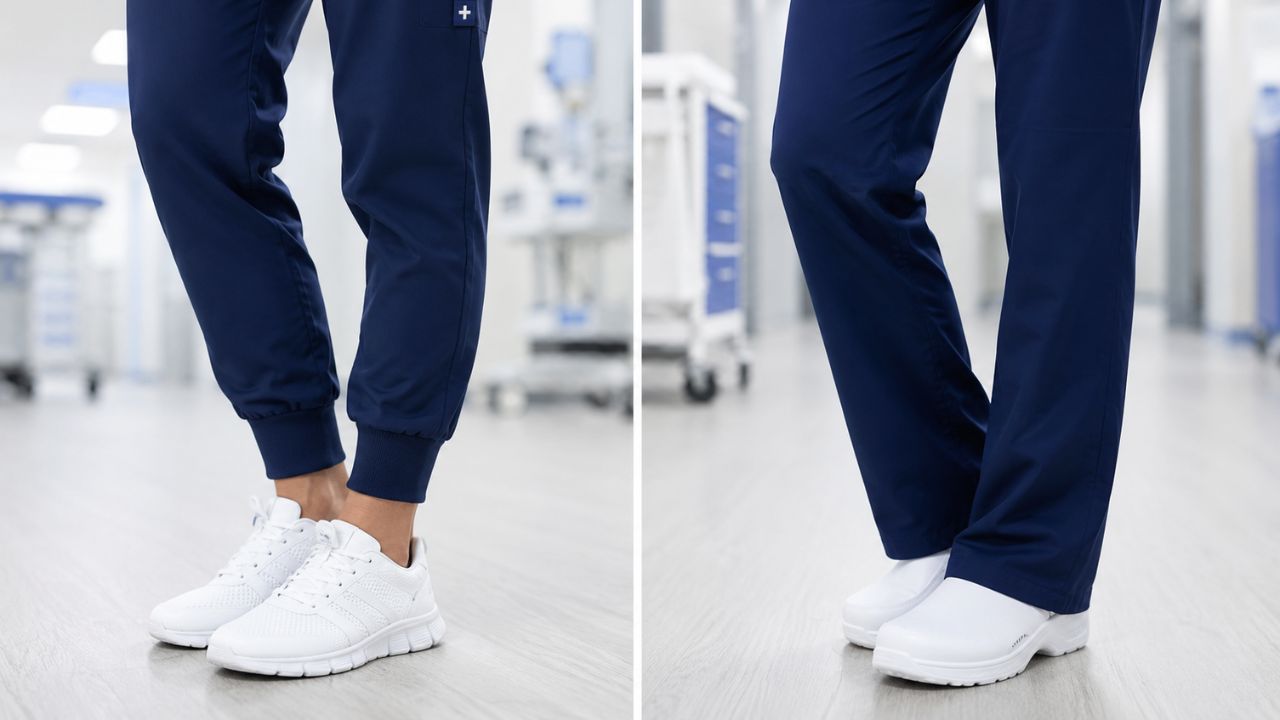
How should nurses decide between joggers and straight-leg scrubs?
Joggers and straight-leg scrubs can both work for nurses. The better choice depends on hem control, airflow, dress code, and personal comfort.
Choose joggers for controlled hems
Joggers are often a good choice when nurses want less fabric movement around the shoe. The cuff can reduce dragging, bunching, and loose fabric at the ankle. This can be helpful during walking-heavy shifts.
Joggers may also feel better for nurses who like a cleaner, more modern shape. The tapered fit can make the uniform feel less bulky while still supporting active work.
Choose straight-leg pants for more airflow
Straight-leg scrub pants may feel better for nurses who want more lower-leg airflow or a roomier fit. Open-hem pants can feel less restrictive around the ankle and calf.
This can be useful for workers who dislike cuffs or prefer a more traditional scrub silhouette. The key is choosing the right inseam so the hem does not drag or bunch.
FAQs
Are jogger scrubs good for nurses?
Jogger scrubs can be good for nurses because the cuffed ankle helps control the hem during walking, bending, and active movement. They are especially useful for nurses who dislike pants dragging or bunching around shoes. The best joggers should also have stretch, breathable fabric, and a secure waistband.
Can nurses wear jogger scrubs at work?
Many nurses can wear jogger scrubs if their workplace dress code allows them. Joggers can look professional when they fit cleanly, use appropriate colors, and are not too tight. Nurses should check uniform rules first because some facilities may prefer traditional straight-leg scrub pants.
Are jogger scrubs comfortable for long shifts?
Jogger scrubs can be comfortable for long shifts when they have stretch fabric, good recovery, breathable construction, and a waistband that stays secure. The cuff should not feel tight around the ankle. Nurses who prefer more lower-leg airflow may feel better in straight-leg scrub pants.
Do jogger scrubs fit tighter than regular scrubs?
Jogger scrubs usually feel more fitted through the calf and ankle because of the tapered leg and cuff. They should not feel tight through the hips, thighs, knees, or lower leg. If the calf or cuff feels restrictive, a different size or pant style may be more comfortable.
What should nurses look for in jogger scrubs?
Nurses should look for jogger scrubs with stretch, fabric recovery, breathable comfort, a secure waistband, and useful pockets. The cuff should control the hem without squeezing the ankle. Pants should also allow bending, sitting, walking, and lifting without pulling through the hips or thighs.
Conclusion
Jogger scrubs are good for nurses who want controlled hems, easier movement, and a modern scrub fit during active shifts. They can be especially useful for walking-heavy workdays because the cuff helps prevent dragging and bunching around the shoe. The best jogger scrubs for nurses should balance stretch, recovery, breathability, waistband comfort, pocket function, and professional fit.